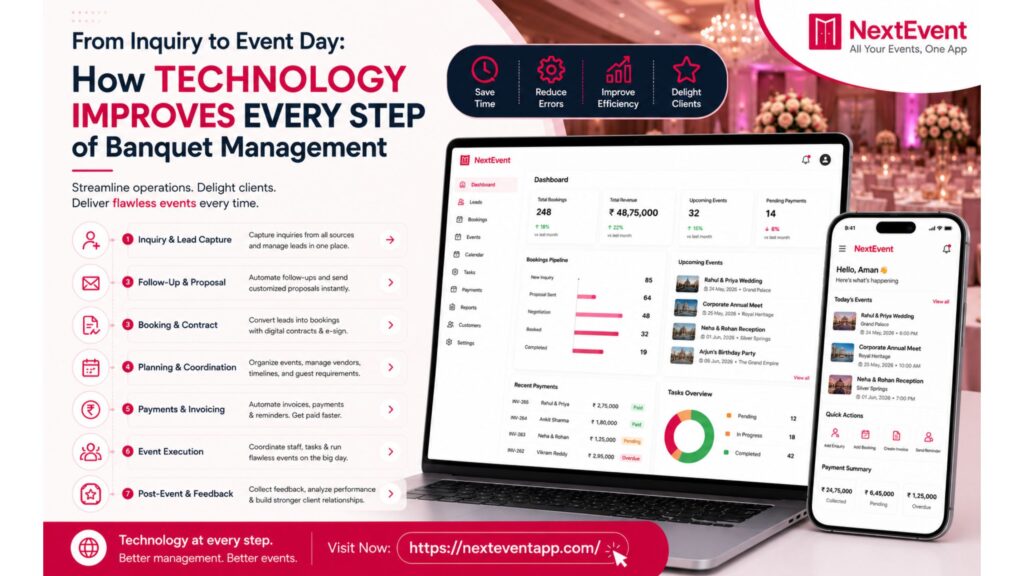
The journey from a customer’s first inquiry to a successful event involves dozens of important steps. From responding to inquiries and confirming bookings to managing payments, coordinating vendors, and ensuring everything runs smoothly on event day, every stage plays a critical role in delivering an exceptional customer experience. Read more here about – The Complete Guide to Automating Banquet Hall Payments, Invoices, and Follow-Ups.
For many banquet halls, these tasks are still managed through paper registers, spreadsheets, phone calls, and messaging apps. While these methods may seem familiar, they often result in delayed responses, missed follow-ups, booking errors, and unnecessary administrative work.
Modern banquet management software transforms this entire process by connecting every stage of the customer journey into one centralized platform. With automation, cloud technology, and smart workflows, venue owners can work more efficiently while providing a seamless experience for customers.
Why Technology Matters in Modern Banquet Management
Customer expectations have changed significantly over the past few years. Today, clients expect:
Quick responses
Transparent pricing
Easy payment options
Accurate booking confirmations
Regular updates
Professional communication
Meeting these expectations manually becomes increasingly difficult as your business grows. Technology helps automate repetitive tasks, reduce errors, and keep every department connected.
Step 1: Managing Customer Inquiries Efficiently
Every event starts with an inquiry. Customers may contact your venue through your website, phone, WhatsApp, email, or social media.
Without a proper system, inquiries can easily be missed or forgotten.
Banquet management software automatically records every inquiry in a centralized CRM, making it easy to:
Capture customer details
Record event requirements
Track communication history
Assign inquiries to staff
Schedule follow-up reminders
This ensures every lead receives prompt attention.
Step 2: Checking Venue Availability in Real Time
One of the first questions customers ask is whether their preferred date is available.
A digital booking calendar allows staff to instantly check:
Available dates
Confirmed bookings
Tentative reservations
Multiple venue availability
Real-time updates help prevent double bookings while making the booking process much faster.
Step 3: Sending Accurate Quotations
After confirming availability, customers expect clear pricing.
Technology simplifies quotation management by allowing staff to prepare professional quotations that include:
Venue charges
Catering packages
Decoration costs
Equipment rentals
Taxes
Payment schedules
Accurate quotations reduce confusion and help customers make informed decisions.
Step 4: Confirming Bookings
Once the customer agrees to the quotation, technology helps finalize the reservation quickly.
Booking software stores:
Customer information
Event details
Hall allocation
Guest count
Advance payment
Special requirements
Everything is saved digitally, eliminating the need for manual paperwork.
Step 5: Simplifying Payment Management
Tracking payments manually often leads to delays and accounting errors.
Automated systems help venue owners:
Record advance payments
Generate GST-compliant invoices
Monitor pending balances
Send payment reminders
Track payment history
This improves cash flow while reducing administrative work.
Step 6: Coordinating Teams and Vendors
Every successful event depends on teamwork.
Technology allows managers to coordinate:
Event coordinators
Decorators
Caterers
Housekeeping
Security
Technical teams
Shared schedules and centralized information ensure everyone stays informed and prepared.
Step 7: Preparing for Event Day
As the event approaches, software helps verify every detail.
Managers can review:
Event timeline
Customer requirements
Seating arrangements
Vendor schedules
Payment status
Staff assignments
Having everything organized in one dashboard reduces last-minute stress and improves execution.
Step 8: Managing Events in Real Time
During the event, managers need quick access to important information.
Cloud-based software allows them to:
Review booking details
Check customer requests
Contact team members
Update event status
Resolve issues quickly
Mobile accessibility ensures smoother event management even when moving around the venue.
Step 9: Following Up After the Event
The customer relationship doesn’t end when the event finishes.
Technology makes post-event communication easy by automating:
Thank-you messages
Feedback requests
Payment confirmations
Future promotional offers
Maintaining communication increases customer satisfaction and encourages repeat business.
Step 10: Measuring Business Performance
Modern banquet management software provides valuable reports that help owners evaluate business performance.
Useful reports include:
Booking trends
Revenue summaries
Payment reports
Customer inquiries
Lead conversion rates
Occupancy reports
These insights help identify opportunities for improvement and support better business decisions.
Key Benefits of Technology in Banquet Management
Adopting modern technology offers several advantages:
Faster inquiry responses
Better booking accuracy
Automated follow-ups
Improved payment collection
Reduced paperwork
Better staff coordination
Real-time reporting
Enhanced customer satisfaction
Cloud-based accessibility
Scalable business operations
Together, these benefits create a more efficient and profitable banquet hall business.
Choosing the Right Banquet Management Software
When selecting software for your venue, consider features such as:
Booking calendar
Customer Relationship Management (CRM)
Payment tracking
GST invoice generation
Automated reminders
Cloud access
Multi-venue management
Business reporting
User-friendly interface
Data security
Choosing software that supports your current operations while allowing room for future growth is a smart long-term investment.
Conclusion
Technology has transformed the way banquet halls operate. From capturing inquiries and managing bookings to automating payments, coordinating staff, and analyzing business performance, digital tools simplify every stage of the customer journey.
Instead of spending valuable time on manual tasks, venue owners can focus on delivering memorable events and building stronger customer relationships.
As the banquet industry becomes increasingly competitive, adopting modern banquet management software is no longer just a convenience—it’s a strategic advantage that helps businesses improve efficiency, increase revenue, and prepare for future growth.
Frequently Asked Questions
1. How does technology improve banquet hall management?
Technology streamlines bookings, customer communication, payments, invoicing, reporting, and staff coordination, making daily operations more efficient and reducing manual work.
2. What is banquet management software?
Banquet management software is a digital platform that helps venue owners manage inquiries, bookings, payments, customer records, calendars, reports, and daily operations from one system.
3. Can technology help prevent double bookings?
Yes. A real-time booking calendar updates availability instantly, helping staff avoid scheduling conflicts and booking errors.
4. Why is automation important for banquet halls?
Automation reduces repetitive tasks, improves payment collection, ensures timely follow-ups, minimizes errors, and allows staff to focus on delivering excellent customer service.
5. Is banquet management software suitable for growing businesses?
Absolutely. Cloud-based banquet management software scales with your business, making it easier to manage higher booking volumes, multiple venues, and larger teams.