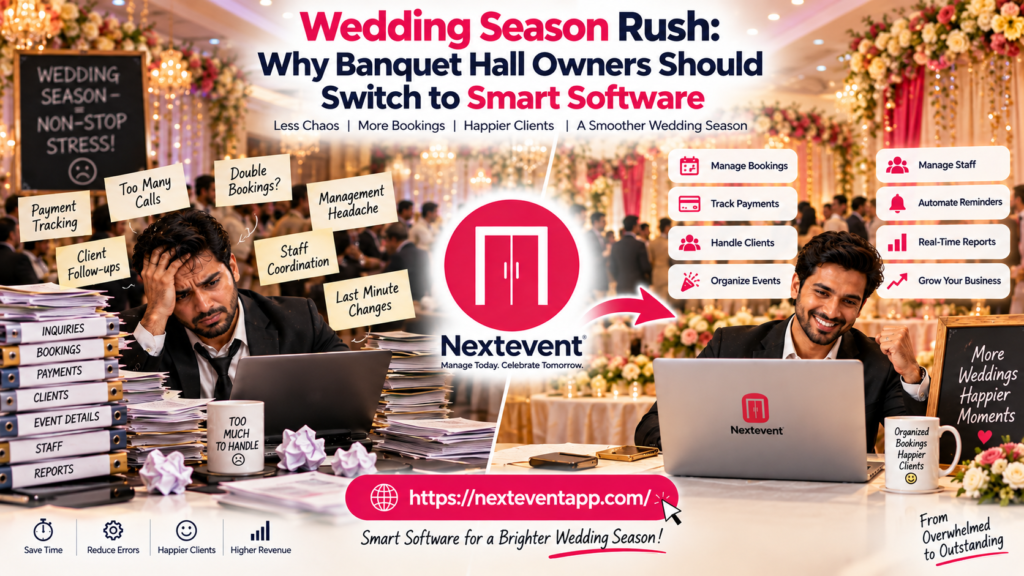
Wedding season can completely change the operating rhythm of a banquet hall. On normal days, a manager may have enough time to respond to enquiries, update a booking register, check payment balances, coordinate staff, and speak with customers. During peak wedding periods, however, those same tasks can arrive simultaneously. One customer may be asking about availability, another may be negotiating a package, a third may be waiting for a quotation, while an existing customer is asking about a pending payment.
This is why wedding season management is not simply about getting more bookings. It is about being able to handle a higher volume of business without allowing small administrative mistakes to become expensive problems. A venue may have excellent infrastructure, attractive décor packages, experienced staff, and strong word-of-mouth marketing, but if enquiries are missed or booking information is scattered across notebooks, spreadsheets and WhatsApp conversations, opportunities can disappear quickly.
The broader wedding economy is also becoming increasingly digital. Business Standard reported that during India’s peak wedding season, customers across categories including banquet halls, caterers, décor providers and other wedding businesses were increasingly using UPI, QR payments and digital credit. This creates an important opportunity for banquet hall owners: if customers are becoming more comfortable with digital processes, venues can modernize their own internal operations as well.
For a banquet hall, smart venue management software works like an additional operations manager. It does not replace the people running the venue. Instead, it gives those people one organized system for handling bookings, enquiries, payments, invoices, reminders, staff access and business information.
More Enquiries, More Decisions, More Pressure
Think about what happens when a popular wedding date suddenly becomes available. Your phone starts ringing. WhatsApp messages arrive. Customers ask about the hall, catering, decoration, rooms, parking, timing, advance payment and available packages. Your sales team may be talking to multiple families at the same time.
Now imagine handling all of this with a physical diary.
The problem isn’t that your staff isn’t working hard. The problem is that manual systems have a capacity limit. Human beings can manage conversations, but they are not databases. When information is spread across different notebooks, Excel files, WhatsApp chats and individual phones, there is always a chance that something will be forgotten.
A smart system creates one source of truth. Instead of asking, “Did someone already talk to this customer?” or “Who blocked this date?” your team can check the system. Instead of searching through messages to find an old quotation, staff can access the customer record. Instead of relying on memory to remember payment dates, automated reminders can handle routine follow-ups. Read more here about – Get Ready for Wedding Season: How Venue Management Software Can Handle More Bookings.
That difference becomes especially valuable when the wedding season brings a sudden increase in enquiries.
The Limits of Manual Venue Management
Manual management can work when a venue has a small number of bookings and a limited team. But as the business grows, the weaknesses become increasingly obvious.
A traditional banquet hall workflow might look like this:
Customer calls → staff writes enquiry in register → manager checks availability → quotation is prepared manually → customer negotiates → advance payment is received → booking is written into a calendar → remaining payment is tracked separately → staff is informed through WhatsApp → invoice is prepared later.
Every arrow in that workflow represents an opportunity for delay or error.
A modern workflow can be much more connected:
Customer enquiry → CRM record → availability check → quotation → follow-up → booking confirmation → payment tracking → automated reminder → invoice → event operations → reporting.
The difference is not simply technology. It is workflow design.
Spreadsheets Cannot Keep Up With Peak Demand
Excel is useful. There is no question about that. Many small businesses have successfully used spreadsheets for years to track customers, payments and bookings. But a spreadsheet is not designed to function as a complete venue-management platform.
Imagine that three employees are working on three different spreadsheets. One has the latest bookings. Another has updated payment information. The third has a list of enquiries. Now a customer calls asking for a complete status update.
Someone has to combine information from multiple sources.
That creates unnecessary friction.
During wedding season, even a small delay can matter. A customer enquiring about a date today may be speaking to three other venues tomorrow. If your team takes too long to respond because someone needs to manually check availability and prepare information, the customer may move elsewhere.
Banquet hall management software brings these processes together. NextEvent, for example, provides booking management, enquiry and lead management, payment tracking, invoices and quotations, automated WhatsApp reminders, staff management and analytics from one platform.
The objective isn’t to eliminate spreadsheets simply because they are old-fashioned. The objective is to give your team a system designed around the actual workflow of a venue.
Missed Follow-Ups Can Mean Lost Bookings
One of the biggest hidden problems during wedding season is not a lack of enquiries. It is lost enquiries.
A family may call on Monday and ask for a quotation. Your staff sends it. The customer says they will discuss it with their family and respond later.
Tuesday becomes Wednesday.
Wednesday becomes Thursday.
Then another venue follows up first.
This happens constantly in sales, particularly when customers are comparing venues.
A smart venue CRM can reduce this problem by keeping enquiry information organized and making follow-up part of the workflow. Customer details, event dates, requirements and communication history can be tracked rather than left inside someone’s memory.
Automated WhatsApp reminders can also reduce the amount of repetitive work your team has to perform manually. NextEvent currently lists automated reminders for bookings, payments, enquiries and important follow-ups among its platform capabilities.
The key idea is simple: every enquiry deserves a follow-up.
During wedding season, that discipline can become a major competitive advantage.
How Smart Software Handles the Booking Rush
The best venue management software is not simply a digital diary. It connects multiple parts of the business.
For banquet halls, that can include availability, bookings, customers, payments, invoices, catering, packages, rooms, staff and reports.
Instead of making employees jump between several tools, a centralized platform gives them a common operational view.
NextEvent describes its platform as a system for banquet halls, function halls, convention centers, lawns, resorts and other event venues, with booking, enquiry, payment, invoicing, menu, package, room, staff, reminder and reporting functionality.
This matters during a rush because every minute spent searching for information is a minute that could have been spent serving customers.
Real-Time Booking Calendar
A booking calendar is one of the most important tools a banquet hall can have.
During peak wedding dates, availability changes quickly. A date might be available in the morning, tentatively held in the afternoon and confirmed by evening. If the information isn’t updated immediately, another staff member may unknowingly offer the same slot to another customer.
That is how double bookings happen.
A smart booking calendar gives the team a shared view of availability. Instead of relying on one person’s diary, the business can work from a centralized schedule.
NextEvent specifically highlights real-time venue booking management and conflict prevention as part of its platform.
For venues managing multiple halls or locations, this becomes even more valuable. A manager should be able to understand availability without calling every employee individually.
The goal is simple: one calendar, one source of truth, fewer booking conflicts.
Centralized Enquiry CRM
A busy wedding season can generate hundreds of conversations.
Some customers are ready to book immediately. Others need quotations. Some are comparing prices. Some want catering details. Some need to discuss dates with family members. Others may return weeks later.
Without a CRM for banquet halls, those conversations can easily become disconnected.
A CRM allows a venue to maintain customer information and track the journey from enquiry to booking. That means the team can understand not only who the customer is, but also what they asked for, what quotation was provided, when the next follow-up is due and whether the booking has been confirmed.
NextEvent’s platform specifically positions enquiry and lead management around capturing enquiries, tracking follow-ups and converting more leads into confirmed bookings.
This changes the sales process from reactive to organized.
Instead of waiting for customers to call again, your team knows who needs attention next.
Turning More Enquiries Into Confirmed Bookings
Getting enquiries is only the beginning.
The real business objective is to turn qualified enquiries into confirmed events.
Consider two banquet halls that receive the same number of enquiries.
Hall A writes every enquiry in a register. Staff members remember some follow-ups. Quotations are sent manually. Payment information is maintained separately.
Hall B records every enquiry in a CRM, follows a structured sales process, sends reminders, tracks quotations and knows which leads are pending.
Which one has a better chance of converting enquiries consistently?
The answer is obvious.
Smart software doesn’t magically create customers. It helps businesses make better use of the customers they already have.
Automated Follow-Ups and WhatsApp Reminders
Follow-up is one of those tasks that looks simple until your enquiry volume increases.
If you receive five enquiries a day, manually following up may be manageable. If you receive 20, 30 or more during a peak period, the task becomes much harder.
Automated WhatsApp reminders for banquet halls can take care of repetitive communication while staff concentrate on conversations that require human attention.
For example, a system can help remind customers about:
-
Pending payments
-
Upcoming booking dates
-
Enquiry follow-ups
-
Important booking updates
-
Scheduled actions
The benefit isn’t only convenience.
It creates consistency.
A customer who receives a timely reminder is less likely to feel forgotten. Meanwhile, your staff does not have to manually remember every routine message.
This is particularly useful during wedding season when dozens of customers may be at different stages of the booking process.
Managing Payments and Billing Without the Chaos
A full booking calendar does not automatically mean healthy cash flow.
A banquet hall might have dozens of confirmed weddings, but customers may pay advances, installments and final balances at different times.
That makes payment tracking essential.
Without a centralized payment system, staff may rely on handwritten notes, spreadsheets or WhatsApp conversations to remember who has paid what.
That can become risky.
Imagine having a wedding worth ₹5 lakh booked six months in advance. The family pays ₹1 lakh as an advance, another ₹1.5 lakh later, and the remaining amount is due shortly before the event.
If payment records are scattered, someone has to manually calculate the balance every time the customer asks.
Software can automate much of this administrative work.
NextEvent lists advance payments, pending payments, due dates and booking-wise balances as part of its payment-management functionality.
GST Invoices and Pending Payment Tracking
Billing becomes another pressure point during wedding season.
Venue bookings can involve multiple components:
-
Hall rental
-
Catering
-
Decoration
-
Rooms
-
Equipment
-
Additional services
-
Packages
-
Add-ons
When these are managed manually, preparing an accurate final invoice can take time.
Modern banquet billing software can help centralize those details and generate invoices and quotations based on the booking information.
NextEvent states that its platform supports GST and non-GST billing, GST invoices and quotations for venue bookings, services and event packages.
The result is a cleaner financial workflow.
Instead of asking, “How much is still pending?” the system can provide the relevant booking information.
Instead of manually creating every quotation from scratch, the team can work from structured booking details.
And when wedding season gets busy, those small time savings add up quickly.
Keeping Staff and Event Operations Connected
A banquet hall is not operated by one person.
There may be a manager, receptionist, accountant, sales executive, chef, decorator, housekeeping team, security staff and other employees involved in delivering an event.
If everyone operates with different information, problems appear.
The receptionist may know the booking date but not the latest payment status.
The accountant may know the payment status but not the updated package.
The manager may know about an additional service that the kitchen team doesn’t know about.
This is where staff management software becomes valuable.
A centralized system allows authorized employees to access the information relevant to their responsibilities. NextEvent includes staff and role management, allowing venues to add team members and control access for different roles.
Think of it as giving the entire team the same map.
Everyone may have a different job, but everyone is moving toward the same destination.
Increase Revenue With Packages and Add-Ons
Wedding season isn’t only about filling your halls.
It is also about increasing the value of each booking.
Suppose a customer books a hall for ₹2 lakh.
During the sales conversation, your team could also offer catering, decoration, rooms, generator services, equipment, additional seating or other relevant services.
If these opportunities are not systematically presented, revenue can be left on the table.
Package and add-on management can help venues structure these offers.
NextEvent includes packages and add-ons alongside menu management, allowing venues to bundle catering, decoration and other services with bookings.
This creates a more organized upselling process.
Instead of saying, “Would you like anything else?” at the end of a conversation, sales staff can present predefined packages.
For example:
|
Package |
Possible Inclusions |
|
Basic Wedding Package |
Hall + Basic Seating |
|
Standard Package |
Hall + Catering + Basic Decoration |
|
Premium Package |
Hall + Catering + Decoration + Rooms |
|
Custom Package |
Selected services and add-ons |
The exact pricing will naturally vary by venue, city, capacity and service quality. But the principle remains the same: make it easier for customers to understand what they can buy from you.
Use Analytics to Make Faster Business Decisions
During wedding season, instinct is useful, but data is better.
A venue owner should be able to answer questions such as:
-
Which months generate the most bookings?
-
Which halls are performing best?
-
How many enquiries became confirmed bookings?
-
How much money is pending?
-
Which packages sell most frequently?
-
Which sources generate the best leads?
-
How many bookings were cancelled?
-
Which dates have the highest demand?
Without analytics, answering these questions may require manually checking multiple registers and spreadsheets.
With venue management analytics, the information can be brought together into reports.
NextEvent includes analytics and reports covering bookings, revenue, payments, occupancy and business performance.
This is where software moves beyond administration.
It becomes a decision-making tool.
If one package consistently produces higher revenue, promote it more aggressively. If one lead source produces lots of enquiries but very few bookings, investigate why. If a particular hall has low utilization, rethink its pricing or marketing.
Data turns business conversations from “I think” into “The numbers show.”
Why Cloud-Based Access Matters in Wedding Season
Venue owners are not always sitting inside their offices.
They may be visiting another property, meeting a customer, inspecting a wedding setup, checking a new construction project or travelling between locations.
That makes accessibility important.
A cloud-based venue management system allows authorized users to access business information from supported devices rather than depending on a single office computer.
NextEvent states that its platform works across Android, iOS and desktop devices.
Imagine a customer calls while you are away from the venue.
Instead of saying, “Let me check the register and call you back,” you can check the relevant information through the system if your access and setup permit it.
For owners managing multiple venues, centralized access becomes even more important.
A multi-venue dashboard can help owners understand bookings, enquiries and payments across locations without maintaining completely separate manual systems.
Why 2026 Is the Right Time to Switch
The technology landscape around Indian commerce is changing rapidly.
Digital payments are now deeply integrated into everyday business. In August 2026, UPI processed 24.51 billion transactions worth approximately ₹29.82 trillion, according to Reuters’ reporting on data and sources around India’s payments infrastructure.
For wedding businesses, the digital shift is particularly relevant because wedding transactions can involve large amounts, multiple vendors and multiple payment stages.
Customers are becoming comfortable with digital interactions.
That raises an important question for venue owners:
If your customers are digital, why should your internal operations remain manual?
Switching to smart software doesn’t mean changing everything overnight. It means gradually replacing repetitive, disconnected processes with a structured system.
For example:
Old approach:
Register + Excel + WhatsApp + calculator + paper invoices.
Smart approach:
CRM + booking calendar + payment tracking + automated reminders + digital invoices + analytics.
The second approach creates a much stronger operational foundation for a busy season.
How to Prepare Your Banquet Hall Before the Rush
Don’t wait until the wedding calendar is completely full before improving your systems.
The best time to prepare is before the rush.
Start by identifying your biggest operational bottlenecks.
Is it enquiry management?
Payment tracking?
Double bookings?
Staff coordination?
Billing?
Customer follow-ups?
Multiple venue management?
Once you identify the biggest problem, choose technology that directly solves it.
For example, if your biggest problem is missed leads, prioritize a banquet hall CRM. If double bookings are your biggest concern, prioritize a real-time booking calendar. If payment follow-ups consume hours every week, look for payment tracking and automated reminders.
NextEvent positions its platform specifically around Indian venue workflows, including banquet halls, function halls, lawns, convention centers and other event venues.
A practical wedding-season preparation checklist could look like this:
|
Area |
What to Prepare |
|
Bookings |
Update all existing confirmed and tentative bookings |
|
Enquiries |
Import or organize active leads |
|
Payments |
Record advances and pending balances |
|
Billing |
Prepare GST/non-GST invoice workflows |
|
Staff |
Create roles and access permissions |
|
Packages |
Update catering and service packages |
|
Follow-ups |
Schedule pending customer follow-ups |
|
Calendar |
Block confirmed and important dates |
|
Reports |
Establish key performance metrics |
|
Training |
Train employees before peak demand begins |
Staff training is particularly important.
Technology only creates value when people actually use it.
Before the season becomes busy, make sure your sales team understands how to create an enquiry, your managers know how to check availability, your accounts team understands payment tracking and your authorized staff know how to update booking information.
The objective is to make the software feel like part of the daily workflow rather than another task employees have to perform.
Smart Software Is About More Than Automation
When people hear the phrase venue management software, they often think about automation.
Automation is certainly important, but it is only one part of the value.
The bigger advantage is visibility.
You can see your bookings.
You can see your enquiries.
You can see your payment status.
You can see your team’s activity.
You can see your revenue.
You can see what needs attention.
That visibility creates control.
And control becomes extremely valuable during a wedding-season rush.
Imagine running a banquet hall like an airport.
Every event has a scheduled arrival and departure. Different teams need to coordinate. Timing matters. Resources need to be available. A small scheduling mistake can affect everyone downstream.
You wouldn’t manage an airport using sticky notes.
Your venue deserves the same operational discipline.
The Cost of Staying Manual
Switching to software has a cost.
But staying manual has a cost too.
It may not appear on your software budget, but it shows up elsewhere:
-
Lost enquiries
-
Missed follow-ups
-
Duplicate work
-
Booking conflicts
-
Delayed quotations
-
Payment delays
-
Billing mistakes
-
Staff confusion
-
Owner dependency
-
Limited visibility
-
Poor customer experience
The most dangerous cost is often the invisible one.
Suppose your team receives 100 enquiries and misses follow-up on 10 of them. If even a few of those customers would have converted, the lost revenue could be significantly higher than the cost of the software that might have helped your team manage those enquiries.
This is why venue owners should think about software as an operational investment, not simply an expense.
The right system should save time, reduce errors, improve follow-up discipline and help the business make better decisions.
NextEvent for the Wedding Season Rush
For banquet hall owners looking for a platform designed around Indian venue operations, NextEvent brings several of these workflows together.
The platform currently offers booking management, enquiry and lead management, payment tracking, invoices and quotations, menu management, packages and add-ons, room booking, staff management, automated WhatsApp reminders and analytics.
It is positioned for banquet halls, function halls, convention centers, wedding lawns, resorts, auditoriums and other event venues.
For wedding lawns specifically, NextEvent also highlights muhurtham-date tracking, automated follow-ups and multi-device access, reflecting the scheduling challenges associated with high-demand wedding dates.
That combination can be particularly useful when the goal is not simply to survive wedding season, but to handle more business with a more organized workflow.
Conclusion
Wedding season creates opportunity, but opportunity comes with pressure.
More customers mean more enquiries. More enquiries mean more follow-ups. More confirmed bookings mean more payments, invoices, staff coordination and event preparation. When all of those activities are managed manually, even a successful wedding season can become an administrative nightmare.
Smart venue management software gives banquet hall owners a way to bring those processes together.
Instead of maintaining separate registers for bookings, spreadsheets for payments, WhatsApp chats for follow-ups and manual invoices for customers, a centralized system can connect the entire workflow.
The result is not just less paperwork.
It is better visibility, faster response times, stronger follow-up discipline, cleaner payment tracking, easier staff coordination and more informed decision-making.
And as Indian customers increasingly embrace digital payments and digital interactions, venues that modernize their internal operations can be better prepared for changing customer expectations.
So, before the next wedding-season rush arrives, ask yourself one question:
If your banquet hall receives more bookings tomorrow, is your current system ready to handle them?
If the answer is no, this may be the right time to switch to smart banquet hall management software.
Frequently Asked Questions
1. Why should banquet halls use software during wedding season?
Wedding season brings a higher volume of enquiries, bookings, payments, customer conversations and staff coordination. Banquet hall management software centralizes these activities, helping teams manage availability, follow-ups, payments, invoices and operations more efficiently.
2. Can venue management software help prevent double bookings?
Yes. A centralized booking calendar can give authorized staff a shared view of venue availability and help identify scheduling conflicts before a booking is confirmed. NextEvent specifically provides booking and conflict-management functionality designed for venue operations.
3. How does CRM help a banquet hall get more bookings?
A banquet hall CRM organizes customer enquiries, contact information, requirements and follow-ups. Instead of allowing potential customers to disappear into WhatsApp chats or paper registers, the team can track each enquiry through the sales process and follow up at the appropriate time.
4. Can banquet hall software track customer payments?
Yes. Modern venue management platforms can track advances, pending balances and payment due dates against individual bookings. NextEvent lists booking-wise payment tracking, advances, pending payments and due dates among its payment-management features.
5. Is smart venue management software useful only for large banquet halls?
No. Software can be useful for small banquet halls, growing function halls, wedding lawns, convention centers and multi-location venue businesses. The most important factor is whether the software matches the venue’s workflow and can scale as the business grows.