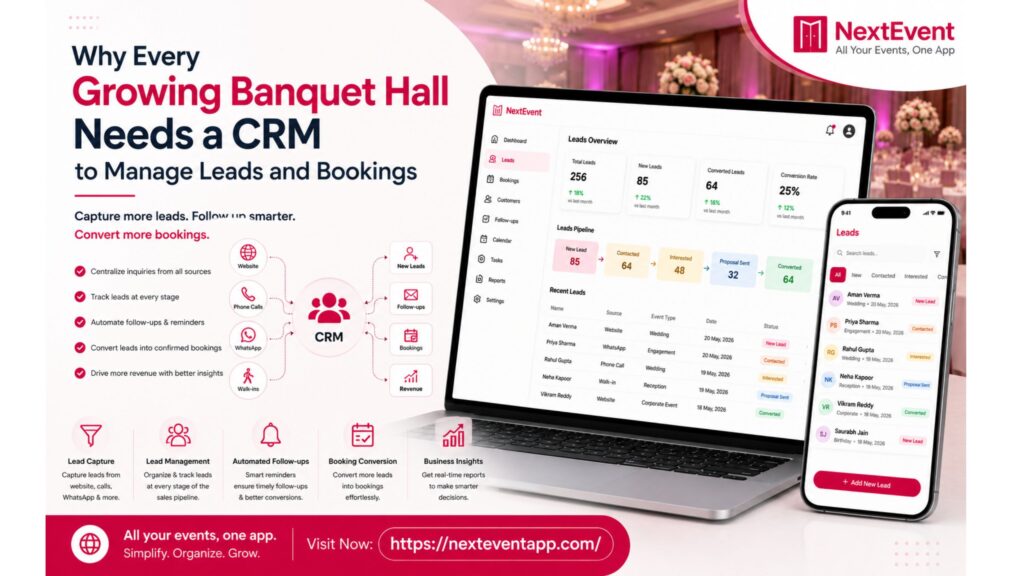
Running a successful banquet hall is no longer just about offering a beautiful venue or competitive pricing. Today’s customers expect quick responses, personalized communication, and a smooth booking experience from their first inquiry to the final event. As the number of inquiries grows, managing every lead manually becomes increasingly difficult. Read more here about – The Ultimate Banquet Hall Operations Checklist for Busy Venue Managers.
Many banquet halls still rely on spreadsheets, notebooks, WhatsApp chats, and phone calls to track inquiries. While this may work for a small number of bookings, it often leads to missed follow-ups, delayed responses, and lost business opportunities.
This is where a Customer Relationship Management (CRM) system becomes essential. A CRM is designed to help banquet hall owners organize customer information, manage inquiries, track follow-ups, and convert more leads into confirmed bookings.
What Is a CRM for Banquet Halls?
A Customer Relationship Management (CRM) system is software that stores and organizes customer information in one place. Instead of searching through messages, emails, or paper records, your team can access every interaction from a single dashboard.
A banquet hall CRM typically includes:
Lead management
Booking tracking
Customer profiles
Follow-up reminders
Payment status
Event history
Communication records
Reports and analytics
With all this information readily available, your team can work more efficiently and provide better customer service.
1. Never Miss a Potential Booking
Every inquiry represents a potential event and a valuable business opportunity. However, without a proper system, inquiries can easily be overlooked.
A CRM automatically records every lead, regardless of where it comes from—your website, social media, phone calls, email, or WhatsApp. This ensures every inquiry is tracked until it is either converted into a booking or marked as closed.
By eliminating missed follow-ups, you increase your chances of winning more business.
2. Respond to Customers Faster
Speed matters in the banquet industry. Customers often contact multiple venues before making a decision.
A CRM allows your team to access customer information instantly, respond quickly, and schedule follow-up reminders. Faster communication creates a professional impression and improves customer confidence in your services.
The sooner you respond, the greater your chances of securing the booking before a competitor does.
3. Organize Customer Information in One Place
Managing customer details across multiple platforms creates unnecessary confusion.
With a CRM, you can store:
Customer names
Contact information
Event dates
Guest count
Preferred services
Payment records
Previous conversations
Special requests
Having everything organized in one place saves time and ensures nothing is overlooked.
4. Improve Follow-Up Management
Many bookings are lost simply because customers aren’t contacted at the right time.
A CRM helps you schedule reminders for:
Quotation follow-ups
Site visits
Pending confirmations
Advance payments
Final payments
Event reminders
Consistent follow-ups demonstrate professionalism and keep your venue top of mind during the customer’s decision-making process.
5. Increase Booking Conversion Rates
A CRM doesn’t just help you collect leads—it helps you convert them.
By tracking every stage of the sales process, you can identify where potential customers drop off and improve your approach.
For example, if many inquiries fail after receiving quotations, you may need to improve your pricing presentation or follow-up strategy.
Better visibility leads to better decision-making and higher conversion rates.
6. Strengthen Customer Relationships
Building long-term relationships is essential for sustainable business growth.
A CRM stores customer history, allowing your team to provide personalized service during future interactions.
You can easily remember:
Previous events
Preferred decoration styles
Special requirements
Anniversary celebrations
Corporate clients
Repeat customers
Personalized communication makes customers feel valued and encourages repeat bookings.
7. Simplify Team Collaboration
Without a centralized system, different team members may provide inconsistent information or duplicate work.
A CRM ensures everyone has access to the same customer records, booking details, and communication history.
Whether someone is handling sales, customer support, or event coordination, the entire team stays informed.
This improves internal communication and creates a smoother customer experience.
8. Gain Valuable Business Insights
Growing businesses need accurate data to make informed decisions.
A CRM provides reports such as:
Number of inquiries received
Lead conversion rates
Booking trends
Revenue performance
Most popular event types
Customer acquisition sources
Staff performance
These insights help identify strengths, improve weak areas, and plan future growth strategies.
9. Save Time Through Automation
Manual data entry consumes valuable working hours.
Modern CRM systems automate routine tasks including:
Lead assignment
Follow-up reminders
Customer notifications
Booking updates
Payment reminders
Report generation
Automation reduces repetitive work, allowing your team to focus on customer service and business development.
10. Scale Your Business with Confidence
As your banquet hall grows, managing operations manually becomes increasingly challenging.
Whether you expand your team, add more event spaces, or open multiple venues, a CRM provides the structure needed to support growth.
Instead of becoming overwhelmed by increasing inquiries, you can manage higher booking volumes efficiently while maintaining excellent customer service.
How CRM Software Supports Long-Term Business Growth
A CRM is more than just a contact database. It becomes the central hub of your banquet hall business.
It helps you:
Improve customer communication
Increase booking conversions
Organize customer records
Track payments
Monitor business performance
Reduce manual work
Enhance team productivity
These improvements contribute directly to higher customer satisfaction and stronger business growth.
Conclusion
As the banquet industry becomes more competitive, customer expectations continue to rise. Venue owners need efficient systems that help them respond quickly, stay organized, and deliver exceptional service.
A CRM provides complete visibility into every inquiry, booking, and customer interaction, ensuring that no opportunity is missed. By improving communication, automating follow-ups, and supporting data-driven decisions, it helps banquet halls operate more efficiently while increasing revenue.
For growing venues, investing in a CRM isn’t just a technology upgrade—it’s a strategic decision that supports long-term success and sustainable growth.
Frequently Asked Questions
1. What is a CRM for banquet halls?
A banquet hall CRM is software that helps venue owners manage customer inquiries, bookings, follow-ups, communication, payment records, and customer information from one centralized platform.
2. How does a CRM increase banquet hall bookings?
A CRM ensures every inquiry is tracked, follow-ups are completed on time, and customer interactions are organized, helping convert more leads into confirmed bookings.
3. Can small banquet halls benefit from CRM software?
Yes. Small banquet halls can improve organization, reduce manual work, enhance customer service, and compete more effectively by using a CRM.
4. What features should a banquet hall CRM include?
A good CRM should include lead management, booking tracking, customer profiles, payment tracking, reminders, reporting, communication history, and cloud access.
5. How does a CRM improve customer relationships?
A CRM stores customer preferences, event history, and communication records, allowing your team to deliver personalized service and build long-term relationships that encourage repeat bookings.