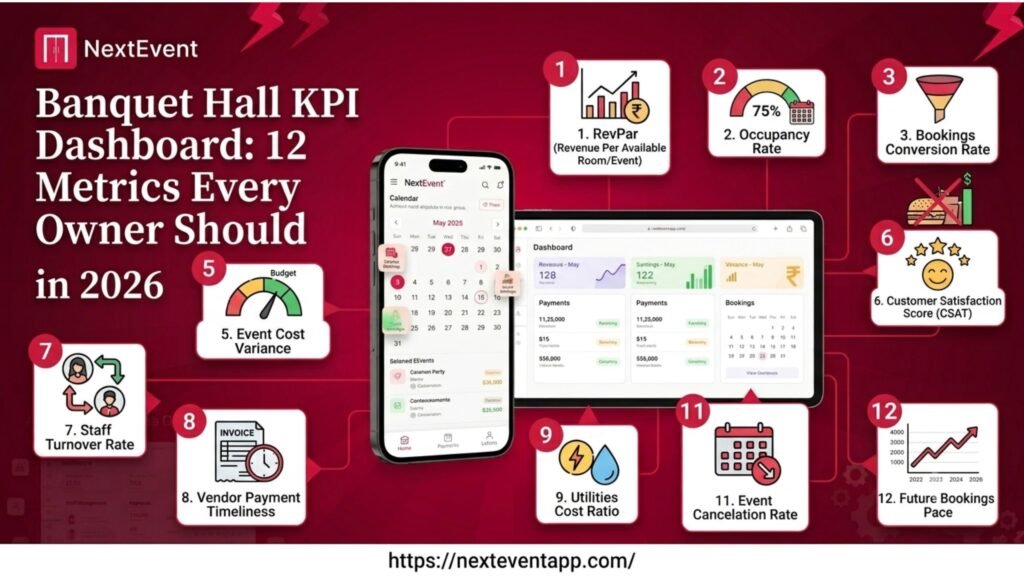
Running a successful banquet hall isn’t just about hosting memorable events—it’s about understanding how your business is performing every day. While many owners focus only on the number of bookings or monthly revenue, these figures don’t tell the complete story. Read more here about – How to Build a Profitable Banquet Hall Business in India.
To grow your business, you need to measure the right Key Performance Indicators (KPIs). A Banquet Hall KPI Dashboard gives you real-time insights into bookings, customer enquiries, payments, staff performance, and revenue, helping you make informed decisions instead of relying on guesswork.
Why KPIs Matter for Banquet Halls
Every decision you make affects your profitability. Without accurate data, it’s difficult to know:
Which marketing campaigns are working
Why bookings are increasing or decreasing
Which services generate the highest revenue
How efficiently your staff is performing
Whether your business is growing month after month
A KPI dashboard transforms raw business data into actionable insights.
1. Total Bookings
The first metric every banquet hall owner should monitor is the total number of confirmed bookings.
Tracking bookings monthly helps you:
Measure business growth
Compare seasonal trends
Plan staffing requirements
Forecast revenue
Consistent growth in bookings usually indicates effective marketing and strong customer demand.
2. Booking Conversion Rate
Not every enquiry becomes a confirmed booking.
Your booking conversion rate measures how many enquiries successfully turn into paying customers.
Formula:
(Confirmed Bookings ÷ Total Enquiries) × 100
If your conversion rate is low, it may indicate:
Slow follow-ups
Poor customer communication
Pricing issues
Strong competition
Using a Banquet CRM helps improve lead management and increase conversions.
3. Monthly Revenue
Revenue remains one of the most important business metrics.
Instead of looking only at yearly income, monitor revenue every month.
A dashboard helps identify:
Seasonal fluctuations
Peak booking periods
Revenue growth
Business performance
Comparing monthly trends allows you to adjust pricing and marketing strategies proactively.
4. Average Booking Value
Knowing the average value of each booking helps you understand customer spending habits.
Formula:
Total Revenue ÷ Number of Bookings
If your average booking value is decreasing, consider offering:
Premium decoration packages
Catering upgrades
Photography services
Additional venue services
Upselling increases profitability without requiring more bookings.
5. Cancellation Rate
Every cancelled booking affects revenue.
Track:
Total cancellations
Cancellation reasons
Cancellation percentage
Seasonal cancellation trends
A high cancellation rate often points to communication issues, unclear policies, or delayed follow-ups.
Modern Banquet Booking Software helps reduce cancellations through automated reminders and payment tracking.
6. Enquiry Sources
Understanding where your customers come from helps you invest your marketing budget wisely.
Track enquiries from:
Google Search
Social media
Wedding portals
Referrals
Google Business Profile
Paid advertising
If referrals generate the highest conversions, you can strengthen your referral program. If Google Search performs well, investing more in SEO can deliver even better results.
7. Lead Response Time
Customers often contact multiple venues before making a decision.
The faster your team responds, the higher your chances of securing the booking.
Monitor:
Average response time
Follow-up completion
Pending enquiries
A Banquet CRM ensures no enquiry is missed and helps your sales team respond promptly.
8. Payment Collection Rate
Managing payments efficiently is critical for maintaining healthy cash flow.
Track:
Advance payments received
Pending balances
Overdue invoices
Payment completion rate
With Banquet Hall Management Software, payment reminders and transaction tracking are automated, reducing the risk of missed collections.
9. Venue Occupancy Rate
Your venue should remain booked as consistently as possible, especially during peak seasons.
Formula:
Booked Days ÷ Available Days × 100
Monitoring occupancy helps you:
Identify slow periods
Launch targeted promotions
Adjust pricing strategies
Optimize venue utilization
Higher occupancy leads to greater profitability.
10. Customer Satisfaction Score
Happy customers generate repeat business and referrals.
Measure customer satisfaction through:
Post-event feedback forms
Online reviews
Ratings
Testimonials
Consistently positive feedback strengthens your brand reputation and attracts more bookings.
11. Staff Productivity
Efficient staff contribute directly to successful events.
Track metrics such as:
Events managed per employee
Task completion rates
Response times
Customer feedback
A centralized dashboard helps managers identify top performers and areas where additional training may be needed.
12. Profit Margin
Revenue alone doesn’t determine success—profitability does.
Track both income and expenses to understand your actual profit margin.
Consider expenses such as:
Salaries
Utilities
Maintenance
Marketing
Catering coordination
Technology costs
A healthy profit margin indicates that your business is operating efficiently.
Why Manual Reporting Isn’t Enough
Many banquet halls still rely on spreadsheets to monitor business performance.
This creates several challenges:
Delayed reporting
Human errors
Duplicate data
Limited insights
Time-consuming calculations
A Banquet Analytics Dashboard automatically updates your KPIs in real time, giving you instant visibility into your business.
How NextEvent Helps You Track Every KPI
NextEvent is designed specifically for banquet halls and event venues.
Its intelligent dashboard provides real-time insights into:
Total bookings
Revenue trends
Lead conversion
Payment status
Customer enquiries
Venue occupancy
Staff performance
Multi-venue operations
Instead of manually creating reports, owners can access accurate business data from one centralized platform.
Whether you’re managing one banquet hall or several locations, NextEvent helps you make faster and smarter business decisions.
Conclusion
Successful banquet halls don’t rely on guesswork—they rely on data.
Tracking the right KPIs allows owners to identify growth opportunities, improve customer service, optimize operations, and increase profitability.
With a modern Banquet Hall KPI Dashboard, you gain complete visibility into your business performance and can respond quickly to changing market conditions.
If you’re looking to streamline operations and make data-driven decisions, NextEvent provides all the tools you need to monitor your business in real time and stay ahead of the competition.
Frequently Asked Questions
1. What is a Banquet Hall KPI Dashboard?
A Banquet Hall KPI Dashboard is a centralized reporting system that tracks key business metrics such as bookings, revenue, customer enquiries, payments, and venue occupancy.
2. Why are KPIs important for banquet hall owners?
KPIs help owners measure business performance, identify growth opportunities, improve customer service, and make informed decisions.
3. Which KPI is the most important?
While all KPIs matter, booking conversion rate, monthly revenue, occupancy rate, and customer satisfaction are among the most critical metrics.
4. Can banquet management software generate KPI reports automatically?
Yes. Modern banquet management software provides real-time dashboards and automated reports, eliminating the need for manual spreadsheets.
5. Why should I choose NextEvent?
NextEvent offers an all-in-one platform with booking management, CRM, payment tracking, analytics dashboards, GST invoicing, and multi-venue support—helping banquet hall owners manage and grow their business efficiently.